Korean Counters for travelers: How to Count Things, People & Food
Beginner Korean · Numbers & Counters
Korean Counters for Beginners: How to Count Things, People & Food
Order drinks, tell a restaurant your party size, buy tickets, and count everyday objects using the right Korean number and counter.
Quick Answer
To count in Korean, use noun + number + counter: 사과 두 개 means “two apples,” 커피 한 잔 means “one cup of coffee,” and 티켓 세 장 means “three tickets.” Many everyday counters use Native Korean numbers, but some—including numbered servings expressed with 인분—commonly use Sino-Korean numbers. Learn each counter with its usual number system instead of assuming one rule fits every counter.
Explore More Korean
Read 개 and 주세요 in Korean
개 — General Item Counter
Romanization: gae
Example: 사과 두 개 — two apples
gae
ㄱ + ㅐ
개 is helpful for many ordinary objects and individually countable items. It may help when a specific counter is forgotten, but it is not natural for every noun.
주세요 — Please Give Me
Romanization: ju-se-yo
Pattern: [item] + [number] + [counter] + 주세요
ju · ㅈ+ㅜ
se · ㅅ+ㅔ
yo · ㅇ+ㅛ
Which Korean Number System Do Counters Use?
Korean uses both Native Korean numbers and Sino-Korean numbers. The counter, meaning, and context determine which system sounds natural.
| System | 1–5 | Common Uses | Example |
|---|---|---|---|
| Native Korean | 하나, 둘, 셋, 넷, 다섯 | Many objects, people, animals, bottles, cups, books, and tickets | 물 두 병 — two bottles of water |
| Sino-Korean | 일, 이, 삼, 사, 오 | Money, dates, minutes, floors, room or route numbers, and numbered portions | 삼 인분 — three servings |
Native Korean Number Forms Before Counters
Some Native Korean numbers shorten immediately before a counter. The important beginner forms are 1, 2, 3, 4, and 20.
| Number | Standalone Form | Before a Counter | Example |
|---|---|---|---|
| 1 | 하나 | 한 | 한 개 |
| 2 | 둘 | 두 | 두 명 |
| 3 | 셋 | 세 | 세 잔 |
| 4 | 넷 | 네 | 네 장 |
| 5 | 다섯 | 다섯 | 다섯 병 |
| 20 | 스물 | 스무 | 스무 명 |
Essential Korean Counters for Daily Life
| Counter | Used For | Number System | Example |
|---|---|---|---|
| 개 · gae | General countable items | Native | 사과 두 개 · two apples |
| 명 / 분 · myeong / bun | People / honorific people | Native | 두 명 / 두 분 · two people |
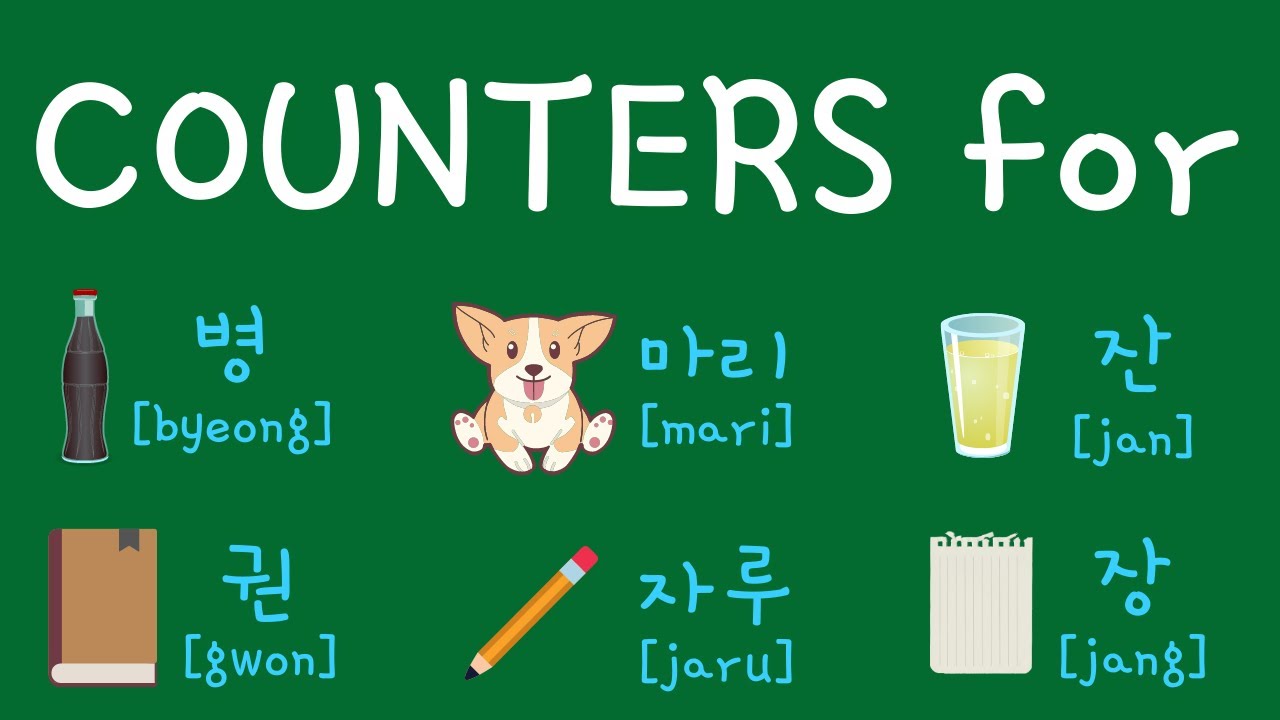
| 잔 · jan | Cups or glasses of drinks | Native | 커피 한 잔 · one cup of coffee |
| 병 · byeong | Bottles | Native | 물 세 병 · three bottles of water |
| 장 · jang | Sheets, tickets, cards, flat items | Native | 표 두 장 · two tickets |
| 권 · gwon | Bound books or volumes | Native | 책 네 권 · four books |
| 마리 · mari | Animals | Native | 고양이 한 마리 · one cat |
| 인분 · in-bun | Restaurant servings or portions | Sino | 삼겹살 이 인분 · two servings of pork belly |
Useful Ordering and Counting Patterns
Ordering: [item] + [number] + [counter] + 주세요
Example: 아이스 아메리카노 두 잔 주세요.
Two iced Americanos, please.
Asking quantity: 몇 + [counter] + 필요하세요?
How many do you need?
Restaurant party size: 두 명이에요.
There are two of us.
| Situation | Korean | Meaning |
|---|---|---|
| Street food | 호떡 두 개 주세요. | Two hotteok, please. |
| Café | 커피 한 잔 주세요. | One cup of coffee, please. |
| Ticket counter | 표 두 장 주세요. | Two tickets, please. |
| Restaurant | 삼겹살 이 인분 주세요. | Two servings of pork belly, please. |
Real-Life Travel Dialogues
1. Entering a Restaurant
Host: 어서 오세요. 몇 분이세요?
Welcome. How many people?
Traveler: 두 명이에요.
There are two of us.
2. Ordering at a Café
Barista: 주문 도와드릴까요?
May I take your order?
Traveler: 아이스 아메리카노 두 잔 주세요.
Two iced Americanos, please.
3. Buying Tickets
Clerk: 몇 장 필요하세요?
How many tickets do you need?
Traveler: 두 장 주세요.
Two, please.
Common Korean Counter Mistakes
- 하나 개 → 한 개: Shorten certain Native Korean numbers before counters.
- 이 명 → 두 명: 명 normally uses Native Korean numbers for a party size.
- 두 인분 → 이 인분: Numbered restaurant portions commonly use Sino-Korean numbers.
- Using 개 for everything: It may be understood for some objects, but learn the common specific counter when possible.
- Forgetting spacing: In standard writing, place a space between the number and counter: 두 개, 세 명, 네 장.
Practice Quiz
Select each question to reveal the answer.
1. How do you say “one cup of coffee”?
Answer: 커피 한 잔. 하나 changes to 한 before 잔.
2. What does 둘 become before a counter?
Answer: 두, as in 두 명 or 두 개.
3. Which counter is used for tickets?
Answer: 장, as in 표 두 장.
4. Which number system is commonly used with 인분?
Answer: Sino-Korean: 일 인분, 이 인분, 삼 인분.
5. What is the counter form of 스물?
Answer: 스무, as in 스무 명.
Frequently Asked Questions
Do all Korean counters use Native Korean numbers?
No. Many everyday object counters do, while other expressions use Sino-Korean numbers. Learn the counter and number system together.
Can I use 개 if I forget the correct counter?
For many ordinary objects, 개 may help communicate your meaning. It is not correct or natural for every category, including people.
What is the polite counter for people?
분 is honorific. A host may ask 몇 분이세요? You can answer 두 명이에요 about your own party.
What is the Korean counter for books?
권: 책 한 권 means one book, and 책 두 권 means two books.
How do I ask “How much is this?”
Say 이거 얼마예요? This asks the price rather than the quantity.
Key Takeaway
Start with 개, 명, 분, 잔, 병, and 장, then learn 권, 마리, and 인분. Remember 한, 두, 세, 네, and 스무 before Native-number counters—and learn important Sino-Korean patterns separately.
