Sino-Korean vs Native Korean Numbers: When to Use Each System
Korean Grammar · Numbers
Sino-Korean vs Native Korean Numbers: When to Use Each System + Counting Guide
Learn which Korean number system to use for prices, time, age, dates, phone numbers, counters, floors, and everyday conversations.
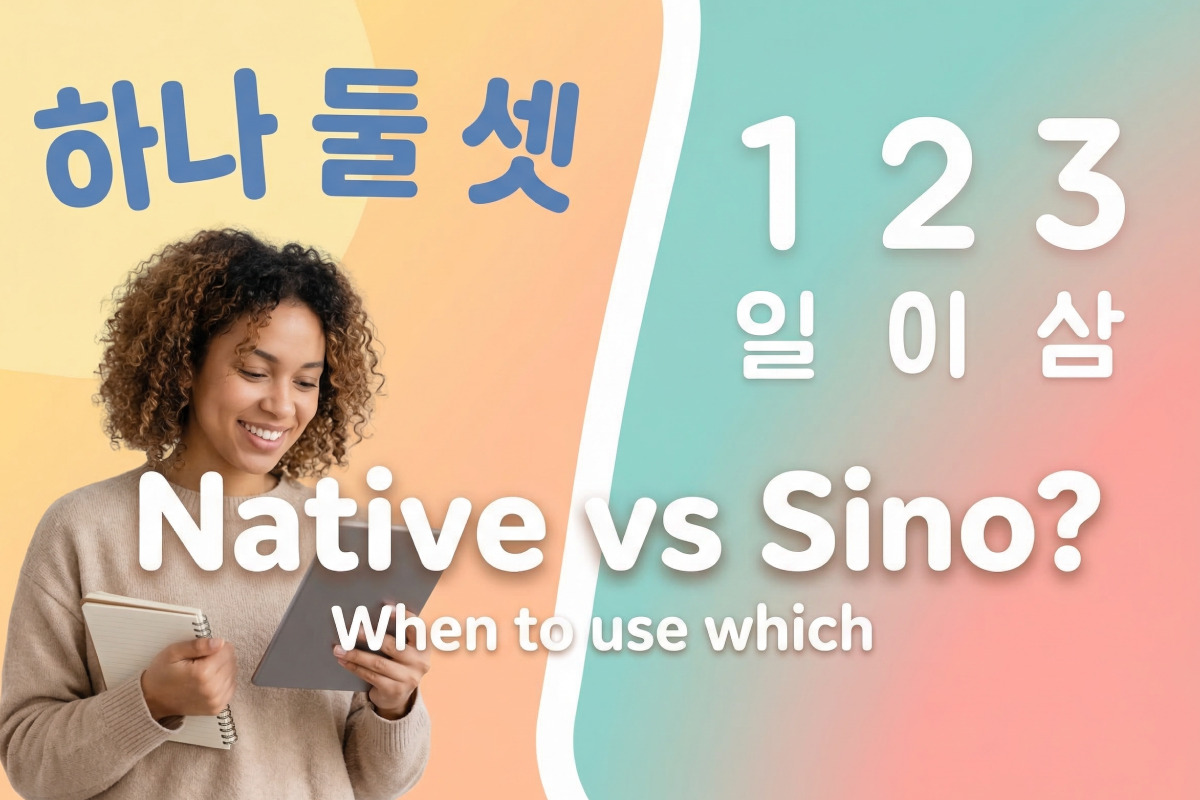
Quick Answer
Use Sino-Korean numbers for prices, dates, phone numbers, floors, route numbers, and numbers 100+. Use Native Korean numbers for age, clock hours, and many common counters such as 명, 개, 잔, and 권.
Build Your Korean Basics
Lesson Summary
- 일, 이, 삼... — Sino-Korean numbers
- 하나, 둘, 셋... — Native Korean numbers
- Clock hours use Native Korean; minutes use Sino-Korean.
- Many common counters use shortened Native forms such as 한, 두, 세, 네.
- Prices, dates, phone numbers, floors, and most labels use Sino-Korean.
What Are the Sino-Korean and Native Korean Numbers 1–10?
Quick answer: Memorize both sets side by side because everyday Korean switches between them depending on context.
| Number | Sino-Korean | Native Korean | Typical Use |
|---|---|---|---|
| 1 | 일 (il) | 하나 (ha-na) | Prices, dates, phone numbers / Counting people or things |
| 2 | 이 (i) | 둘 (dul) | Prices, dates / Native counters |
| 3 | 삼 (sam) | 셋 (set) | Floors, dates / Native counters |
| 4 | 사 (sa) | 넷 (net) | Phone numbers, prices / Native counters |
| 5 | 오 (o) | 다섯 (da-seot) | Dates / Native counters |
| 6 | 육 (yuk) | 여섯 (yeo-seot) | Basic Sino-Korean form is 육; pronunciation may change in compounds |
| 7 | 칠 (chil) | 일곱 (il-gop) | Dates / Native counters |
| 8 | 팔 (pal) | 여덟 (yeo-deol) | Prices / Native counters |
| 9 | 구 (gu) | 아홉 (a-hop) | Phone numbers / Native counters |
| 10 | 십 (sip) | 열 (yeol) | Dates / Native counters |
When Should You Use Sino-Korean Numbers?
Quick answer: Think prices, dates, phone numbers, addresses, floors, route numbers, measurements, and large numbers.
| Situation | Number System | Example | Key Note |
|---|---|---|---|
| Prices | Sino-Korean | 오천 원 = 5,000 won | Learner rule: prices use Sino-Korean numbers |
| Calendar dates | Sino-Korean | 8월 22일 = August 22 | 6월 is pronounced 유월; 10월 is 시월 |
| Phone numbers | Sino-Korean digits | 010-1234-5678 | Read digit by digit; pauses usually replace hyphens |
| Addresses / room / route numbers | Sino-Korean | 302호, 3번 출구 | Common with labels and identifiers |
| Clock hours | Native Korean + 시 | 세 시 = 3 o'clock | Hours use Native Korean |
| Clock minutes | Sino-Korean + 분 | 십오 분 = 15 minutes | Time uses both systems |
| Age | Usually Native Korean + 살 | 스무 살 = 20 years old | Formal documents may use Sino-Korean-style age expressions |
| Counting common objects | Usually Native Korean + counter | 사과 두 개 = two apples | Many everyday counters use Native Korean |
| 100 and above | Sino-Korean | 백, 천, 만 | Modern everyday Native Korean counting does not normally extend beyond 99 |
When Should You Use Native Korean Numbers?
Quick answer: Native Korean numbers are especially common for age, clock hours, and counting everyday people or objects with common counters.
- Age: 스무 살 = 20 years old.
- Clock hours: 세 시 = 3 o'clock.
- People: 두 명 = two people.
- Items: 세 개 = three items.
- Cups/glasses: 한 잔 = one cup/glass.
- Duration: 두 시간 = two hours.
Why Do Native Korean Numbers Change Before Counters?
Quick answer: Several common Native Korean numbers have shortened forms before counters.
한 명 · 한 개 · 한 시
두 명 · 두 개 · 두 시
세 명 · 세 개 · 세 시
네 명 · 네 개 · 네 시
스무 살
Which Korean Counters Use Which Number System?
Quick answer: Learn counters together with the number system they normally take.
| Counter | Meaning | Typical Number System | Example |
|---|---|---|---|
| 명 / 분 | People / honorific people counter | Native Korean | 세 명 = three people · 세 분 = three people (honorific) |
| 개 | General items | Native Korean | 두 개 = two items |
| 잔 | Cups / glasses | Native Korean | 한 잔 = one cup/glass |
| 병 | Bottles | Native Korean | 세 병 = three bottles |
| 권 | Books / bound volumes | Native Korean | 두 권 = two books |
| 시 | Clock hour | Native Korean | 세 시 = 3 o'clock |
| 분 | Minutes | Sino-Korean | 십오 분 = 15 minutes |
| 층 | Floor / story | Sino-Korean | 3층 = 삼 층 (sam-cheung) |
| 번 | Number / occurrence / route | Often Sino-Korean in labels and route numbers | 3번 출구 = Exit 3 |
How Do Korean Numbers Work When Telling Time?
Quick answer: Korean clock time combines both systems: Native Korean for the hour and Sino-Korean for the minutes.
se si sip-o bun
3:15
세 시 uses Native Korean because 시 is the clock-hour counter. 십오 분 uses Sino-Korean because clock minutes use 분 with Sino-Korean numbers.
For duration, Korean commonly uses Native Korean + 시간: 두 시간 = two hours. This is different from the clock-hour expression 두 시 = 2 o'clock.
How Should You Understand Sino-Korean Word Origins?
si-gan — time / duration
Hangul reading: 시 + 간. Sino-Korean origin: 時 = time, 間 = interval/space. The meanings come from the underlying Hanja, not from the Hangul syllables themselves.
wol-yo-il — Monday
월 (月) = moon/month · 요일 (曜日) = day of the week. Do not treat 요 as a Hangul syllable that independently means “day.”
ga-gyeok — price
The word comes from the Sino-Korean form 價格. The meanings belong to the underlying Hanja, not to the Hangul blocks 가 and 격 by themselves.
Real-Life Dialogues Using Both Number Systems
Dialogue 1: At a Cafe
A-me-ri-ka-no du jan ju-se-yo.
Two Americanos, please.
Man won-im-ni-da.
It's 10,000 won.
Dialogue 2: Asking the Time
Ji-geum myeot si-ye-yo?
What time is it now?
Ne si i-sip bun-i-e-yo.
It's 4:20.
What Common Korean Number Mistakes Should Beginners Avoid?
Quick answer: The biggest mistakes are using the wrong system with counters, forgetting shortened Native forms, and overgeneralizing simple rules.
- 육 vs 유: the basic number 6 is 육. Do not memorize 유 as a standalone alternate digit.
- Phone numbers: read digits individually; hyphens are usually pauses, not 에.
- Floors: 3층 is 삼 층 (sam-cheung), not “sam-cheong.”
- Hours vs minutes: hours use Native Korean + 시; minutes use Sino-Korean + 분.
- Counters: many use Native Korean, but not all.
- Hangul breakdown: a Hangul syllable does not automatically carry a Hanja-derived meaning by itself.
Mini Korean Numbers Quiz
1. Which system should you use for 5,000 won?
A) Native Korean
B) Sino-Korean
2. Which is correct for “three people”?
A) 삼 명
B) 세 명
3. How do you say 3:15?
A) 삼 시 열다섯 분
B) 세 시 십오 분
4. Which month pronunciation is correct?
A) 육월
B) 유월
Show Answers
1. B · 2. B · 3. B · 4. B
Frequently Asked Questions
Why does Korean have two number systems?
Korean uses both a Native Korean system and a Sino-Korean system derived historically from Chinese. Modern Korean assigns them to different situations such as prices, dates, counters, and time.
Which system should beginners learn first?
Learn both 1–10 early, but prioritize Sino-Korean for prices, dates, phone numbers, and large numbers, and Native Korean for age, clock hours, and common counters.
Why does 하나 become 한 before counters?
Some Native Korean numbers change form before counters: 하나 → 한, 둘 → 두, 셋 → 세, 넷 → 네, and 스물 → 스무.
Do all counters use Native Korean numbers?
No. Many common everyday counters do, but not all counters and measurement expressions follow that rule. For example, floors use Sino-Korean numbers with 층, and minutes use Sino-Korean numbers with 분.
How do you say 6월 and 10월?
6월 is pronounced 유월 (yu-wol), and 10월 is pronounced 시월 (si-wol). These are standard irregular month pronunciations.
Conclusion
The easiest way to master Korean numbers is to stop thinking of Sino-Korean and Native Korean as interchangeable. Learn each number together with the situations where it belongs. Use Sino-Korean for prices, dates, phone numbers, floors, and large numbers; use Native Korean for age, clock hours, and many everyday counters.
Then focus on the mixed situations—especially time and counters. Once 세 시 십오 분, 두 명, and 오천 원 feel automatic, the two-system structure becomes much easier.
