Essential Korean Phrases for Public Transportation
Travel & Transit Expressions
Essential Korean Phrases for Public Transportation
Learn practical Korean for subways, buses, taxis, transfers, T-money, directions, payments, and public transit etiquette.
Lesson Summary
- 지하철 means subway, 버스 means bus, and 택시 means taxi.
- 환승 means transfer, and 출구 means exit.
- Use 어디에 있어요? to ask where a station, stop, or exit is.
- Use (으)로 가주세요 to tell a taxi driver your destination.
Quick Answer
Ask whether a bus goes somewhere with 이 버스 [destination] 가나요?. Ask where to transfer with 어디서 환승해요?. In a taxi, say [destination](으)로 가주세요.
How Korean Transportation Language Works
Use 어디에 있어요? for locations, 어디서 타요? for boarding points, 가나요? to check a route, and 얼마나 걸려요? to ask travel time.
South Korea boasts one of the most efficient, clean, and modern transportation networks in the world. Whether you are navigating the extensive Seoul Metropolitan Subway, catching a city bus, or taking a local taxi, knowing essential Korean phrases for taking public transportation will make your journeys smooth, stress-free, and enjoyable.
In this comprehensive guide, you will master core vocabulary for subways, buses, and taxis, learn key sentence patterns to ask for directions, understand transit card (T-money) operations, and discover crucial Korean transit etiquette.
What Korean transportation vocabulary should beginners know?
Key words include 지하철 for subway, 버스 for bus, 택시 for taxi, 출구 for exit, and 환승 for transfer.
Start by building your foundation with these high-frequency Korean words related to vehicles, transit hubs, and payment:
| English Meaning | Hangul | Romanization | Pronunciation Guide |
|---|---|---|---|
| Subway | 지하철 | ji-ha-cheol | Jee-hah-cheol |
| Bus | 버스 | beeo-seu | Beoh-seu |
| Taxi | 택시 | taek-si | Taek-shee |
| Subway Station | 지하철역 | ji-ha-cheol-yeok | Jee-hah-cheol-yeok |
| Bus Stop | 버스 정류장 | beo-seu jeong-ryu-jang | Beoh-seu jeong-ryu-jahng |
| Transportation Card | 교통카드 | gyo-tong-ka-deu | Gyoh-tohng-kah-deu |
| Exit (e.g., Station exit) | 출구 | chul-gu | Chool-goo |
| Transfer | 환승 | hwan-seung | Hwahn-seung |
What Korean phrases are useful on subways and buses?
Use 교통카드 충전해 주세요 to recharge a transit card, 어디서 환승해요? to ask where to transfer, and 이번 역에서 내려야 해요 to say you need to get off here.
When riding subways or city buses in Korea, you will frequently need to buy passes, recharge your transportation card, or ask about specific stops.
Top Subway and Bus Phrases:
• 교통카드 충전해 주세요.
(Gyo-tong-ka-deu chung-jeon-hae ju-se-yo.)
→ "Please recharge my transit card."
• 이 버스 명동 가나요?
(I beo-seu Myeong-dong ga-na-yo?)
→ "Does this bus go to Myeongdong?"
• 다음 정류장이 어디예요?
(Da-eum jeong-ryu-jang-i eod-i-ye-yo?)
→ "Where is the next stop?"
• 이번 역에서 내려야 해요.
(I-beon yeok-e-seo nae-ryeo-ya hae-yo.)
→ "I have to get off at this station."
• 어디서 환승해요?
(Eod-i-seo hwan-seung-hae-yo?)
→ "Where do I transfer?"
You can buy a T-money card at any convenience store (GS25, CU, Seven Eleven) in Korea. Tap your card when entering and exiting both subways and buses to qualify for seamless, discounted transfer fares within a 30-minute window!
How do you ask for transit directions in Korean?
Use 어디에 있어요? to ask where a place is, 어디서 타요? to ask where to board, and 얼마나 걸려요? to ask travel time.
If you are lost or looking for a specific entrance or exit, use the universal directional grammar pattern: [Location] + 어디에 있어요? ([Location] eod-i-e iss-eo-yo?).
| English Request | Korean Expression | Romanization |
|---|---|---|
| Where is the subway station? | 지하철역이 어디에 있어요? | Ji-ha-cheol-yeok-i eod-i-e iss-eo-yo? |
| Where is Exit 3? | 3번 출구가 어디예요? | Sam-beon chul-gu-ga eod-i-ye-yo? |
| Where can I take line 2? | 2호선 어디서 타요? | I-ho-seon eod-i-seo ta-yo? |
| How long does it take to get to Seoul Station? | 서울역까지 얼마나 걸려요? | Seo-ul-yeok-kka-ji eol-ma-na geol-ryeo-yo? |
What Korean phrases do you need in a taxi?
Say [destination](으)로 가주세요 for “Please take me to [destination],” 여기서 세워주세요 for “Please stop here,” and 카드로 계산할게요 for “I will pay by card.”
While subways and buses cover almost everything, taxis are extremely convenient and reasonably priced in Korean cities. Here are key phrases to state your destination and communicate with the driver:
• [Destination](으)로 가주세요.
([Destination]-(eu)ro ga-ju-se-yo.)
→ "Please take me to [Destination]." (e.g., 서울역으로 가주세요 — Please go to Seoul Station.)
• 여기서 세워주세요.
(Yeo-gi-seo se-wo-ju-se-yo.)
→ "Please pull over / stop here."
• 얼마나 걸려요?
(Eol-ma-na geol-ryeo-yo?)
→ "How long will it take?"
• 카드로 계산할게요.
(Ka-deu-ro gye-san-hal-ge-yo.)
→ "I will pay by credit card."
What public transportation etiquette should travelers follow in Korea?
Keep your voice low, respect priority seats, queue before boarding, and avoid blocking doors or carrying uncovered food onto buses.
To ensure a pleasant ride for everyone, keep these important cultural norms in mind when riding public transit in Korea:
- Keep Your Voice Down: Avoid loud phone calls or animated conversations on subways and buses. Most passengers read, browse their phones, or sleep quietly.
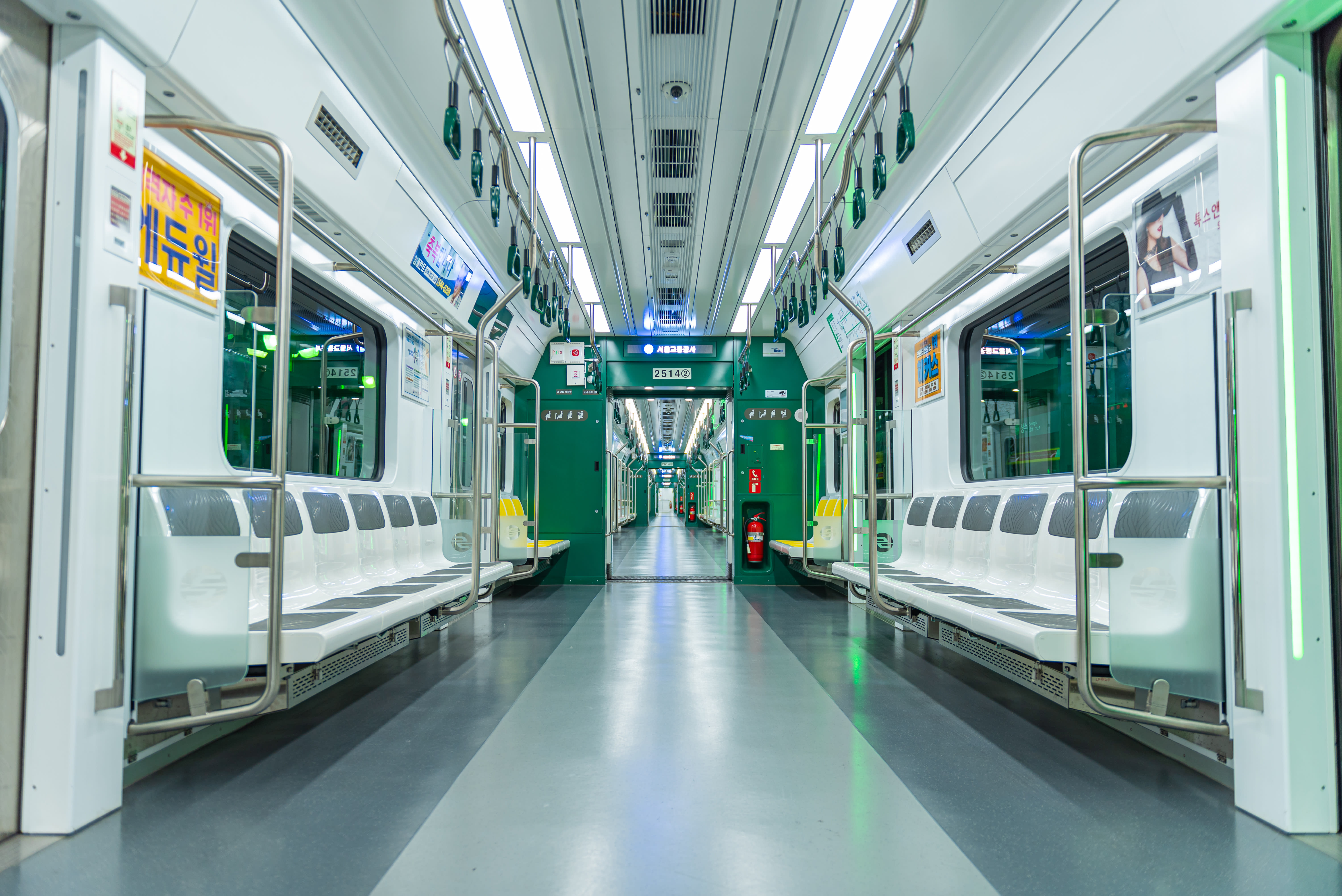
- Respect Priority Seating: Leave the yellow/red priority seats (노약자석) at the ends of subway cars open for elderly, disabled, or pregnant passengers, even if the train is empty.
- Always Tap Off: Remember to tap your T-money card against the sensor when exiting buses. If you forget to tap off, you will lose your transfer discount and incur a distance penalty fee.
- No Uncovered Food or Drinks: Carrying open coffee cups or hot food onto city buses is strictly prohibited in major cities like Seoul.
Korean Transit Culture Tips
- Queue behind marked lines and let passengers exit before boarding.
- Keep conversations and phone calls quiet.
- Respect priority seating.
- Keep your destination written in Hangul when taking a taxi.
Common Mistakes to Avoid
- Do not confuse 출구 with 환승.
- Check the line number and travel direction before boarding.
- Use polite endings with drivers and staff.
- Confirm current schedules and payment rules because they can vary.
Real-World Korean Transit Scenarios
- Checking a bus route: 이 버스 홍대 가나요?
- Finding an exit: 3번 출구가 어디예요?
- Asking where to transfer: 어디서 환승해요?
- Stopping a taxi: 여기서 세워주세요.
Quick Knowledge Check
Choose the correct phrase for each transportation scenario.
Question 1: You want to ask a bus driver if the bus goes to Hongdae. What should you say?
A) 홍대 가나요? (Hong-dae ga-na-yo?)
B) 여기서 세워주세요 (Yeo-gi-seo se-wo-ju-se-yo)
C) 교통카드 충전해 주세요 (Gyo-tong-ka-deu chung-jeon-hae ju-se-yo)
Question 2: What does "환승" (hwan-seung) mean?
A) Exit
B) Transfer
C) Bus Stop
Question 3: You are in a taxi and want the driver to drop you off right here. What should you say?
A) 얼마예요? (Eol-ma-ye-yo?)
B) 3번 출구가 어디예요? (Sam-beon chul-gu-ga eod-i-ye-yo?)
C) 여기서 세워주세요 (Yeo-gi-seo se-wo-ju-se-yo)
Question 4: How do you ask "Where is the subway station?" in Korean?
A) 지하철역이 어디에 있어요? (Ji-ha-cheol-yeok-i eod-i-e iss-eo-yo?)
B) 카드로 계산할게요 (Ka-deu-ro gye-san-hal-ge-yo)
C) 다음 정류장이 어디예요? (Da-eum jeong-ryu-jang-i eod-i-ye-yo?)
Show Answers
Answers:
1. A) 홍대 가나요? — Used to check if a vehicle goes to a specific destination.
2. B) Transfer — 환승 refers to transferring between subways or buses.
3. C) 여기서 세워주세요 — Means "Please stop/pull over here."
4. A) 지하철역이 어디에 있어요? — "지하철역" means subway station, and "어디에 있어요?" means where is it.
Frequently Asked Questions
Can I use a credit card instead of T-money on Korean subways?
International credit cards generally do not work directly at subway turnstiles. It is best to purchase a physical T-money card or use a Korea Tour Card loaded with local cash KRW.
How do I say "transfer" in Korean?
The word for transfer is 환승 (hwan-seung). You will see this word on station signs and overhead banners indicating line transfer passageways.
What should I do if I get on the wrong subway train in Korea?
Simply get off at the next station. Look for signs pointing to the opposite direction platform or cross over using transfer bridges. You can ask staff: "반대 방향 어디예요?" (Where is the opposite direction?).
Do Korean taxi drivers speak English?
While some drivers speak basic English, many elderly taxi drivers do not. Showing your destination address written in Hangul or speaking "[Destination]로 가주세요" guarantees a smooth trip.
Are subways in Seoul open 24/7?
No, subways in major cities usually run from around 5:30 AM to midnight. After midnight, you can take late-night "Night Owl" (올빼미) buses or use taxis.
Conclusion
Riding subways, buses, and taxis in Korea is simple once you memorize these essential Korean phrases for taking public transportation. Key phrases like "지하철역이 어디에 있어요?" (Where is the subway station?) and "여기서 세워주세요" (Please stop here) will give you total independence as you explore South Korea. Keep your T-money card ready, practice these phrases, and travel with ease!
